Showing posts with label carrots. Show all posts

9.08.2013

purple carrots

When any of us think of carrots, the first thing that comes to mind is a bright orange vegetable. But if you do some research into the history of carrots (I know, I'm a dork), you'll find that orange carrots are a relative novelty compared to  the other colors of carrots.

Remember when I wrote about yellow carrots? Until the 1600s, carrots were usually one of two colors: yellow, like I posted about before, and PURPLE.
The lighting is bad here... but these carrots were actually really dark! I got them from my CSA, and had first thought they must be a trendy new breed of carrots. Little did I know it's actually a very old strain!

A little internet sleuthing (supported by the Carrot Wikipedia page) tells me that orange carrots were cultivated in the Netherlands in the 1600s in honor of the House of Orange. Before that, any recipe that called for carrots either had white-ish, yellow, or purple carrots!
They taste just the same as orange carrots, but feel much more historic (ha ha). Here we enjoyed them raw in a salad.

5.31.2011

Golden Beets

I tried to get a "food in books" post up and running for you for this month, but it looks like we'll just have to double up next month, because I haven't had time. BUT sneak preview: I'll be cooking from Hardy's The Mayor of Casterbridge, and if you've read the book I bet you can guess what I'll be making. If you haven't, you're in for a (mushy) treat.

This entry is devoted to yellow food that isn't usually yellow. Namely, the Golden Beet. It may just be that I like yellow better than pink, but I personally think that golden beets taste better than their red counterparts--a little milder, so the flavor really stands out. You may remember that I used them in the Wild Rice Salad with Oranges and Roasted Beets in my last entry.

I really love them roasted, especially on salads:
Chopped small on a side salad (chickpea cutlet in the back! whoo!).

Making a nice beety halo around a wilted greens salad.

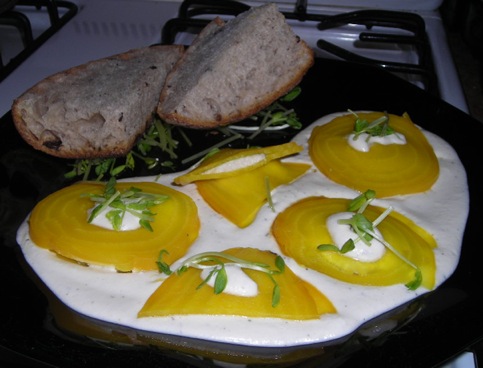
And my faaaavorite way to eat them: as raw ravioli with nut cheese!
Confession: in this picture, the beets had been roasted. But I've made this dish twice, and I swear the first time they were raw! And having bread on the side made the meal not raw anyway. The raviolis are filled with a thick almond/cashew cheese, which is watered down a little and given italian herbs to make the cream sauce. Yum!

Finally, while these aren't golden beets, they're a golden version of something else that's usually gold: carrots.
Have you ever tried yellow carrots? They taste exactly the same, but make me feel like I'm eating a different vegetable. I imagine eating purple carrots would be the same...

12.22.2010

Great Expectations: hearty rolls and stew

I love food and I love to read. As a result, the first week [or the third week...] of each month, I'll combine these two interests in a post about food from literature. I'll mostly be sticking with books from classic literature, so you're likely to know the storylines anyway, but just in case you don't: warning: there may be spoilers ahead.

---------------------------------------------------------------------------------


This time of year, everyone pays attention to Charles Dickens's A Christmas Carol, which, despite all the corny movies and TV specials based on it, is a good story. But for my "food in literature" post this month, I want to talk about another of his famous works: Great Expectations.
A lot of people read this book in high school or at least college, but I somehow avoided ever having to read Dickens in an academic setting, so in reading this book, which everyone else implied was long and heavy, I found a pleasant surprise. It's long, and it's a dreary story, but the characters are very much alive and interesting, and the grime and gloom of Dicken's Victorian England is positively palpable. Few of the characters are really likeable, but you want to give them the benefit of a doubt; it is their environment that makes them who they are.

And what an environment! The settings in Great Expectations could be characters on their own. We visit and revisit the graveyard, the swampy Kent marshes, Miss Havisham's ruined mansion, the dingy London apartment, the ominous lawyer's office--they build up around the characters and the reader like a tall wall. Dickens's Victorian England is gray, depressing, and oppressive. But there are respites! There are some good people, and in this book, the good people are accompanied by good places--and good food. I always invoke food in literature as a depiction of comfort and emotional (as well as physical) nourishment; Great Expectations seems to do the same. Joe, the Pockets, and Wemmick are some of the most likeable characters in the book, and the homes of these people are the few sources of warmth and light that Great Expectations offers. And with all of these people, Pip eats food.

There is a fair amount of alcohol, and some tea, but we do not see many of the characters' meals. Because food does not appear often in the book, when it does appear, it is obvious that it has an important role. Early in Pip's life, we see that the abused little boy takes a great deal of comfort in eating bread with Joe, his sister's kind husband. At the uncomfortable Christmas dinner, Joe gives Pip extra gravy to try to make up for the boy's treatment. When Pip comes into money, one of the first things he does in London is eat with Herbert Pocket--buttered chicken and parsley, strawberries for dessert. And when he meets Wemmick, a trusty advisor and friend, Wemmick invites him back to his eccentric but endearing house for a homegrown meal.

As I said a couple weeks ago, I was originally going to recreate a vegan version of a Pork Pie. But then I read what pork pies are; ground-up season pork surrounded by pork-flavored gelatin in a pie shell. I thought about grinding up and seasoning tofu, making an agar-tofu-jelly, and baking that, but it still doesn't sound appetizing. More revolting than comforting. I realized, though, that Pip never ate the Pork Pie; it was not a source of comfort to him. The bread that he and Joe share early in the book and the simple meal of stewed vegetables that they pull from Wemmick's garden are not only more appetizing, but much easier to veganize.
Wemmick's stew isn't vegan--he adds fish--but my Autumn Root Stew is actually probably pretty close to the recipe Dickens had in mind. This time I added a cup or so of chickpeas for protein.

Pull-apart rolls are fond memories from my childhood, and this reminded me of Pip's fond moments eating bread with Joe. I like to add some whole wheat flour (not whole wheat pastry flour!) for extra heartiness, but you can do all white flour if you prefer. You'll probably end up using a little less water, though. If you want to replace MORE of the white four with whole wheat flour, add a couple Tbsps of gluten flour to make it stick together and rise better, and you may need more water.
Hearty Pull-Apart Rolls
Makes 12 rolls

3 tsps active dry yeast (you can also use a packet, but that's less yeast, so give it a little more rising time)
1 tsp sugar
1 Cup warm (not hot) water
2 Tbsp oilve oil, divided
1/2 tsp salt
2 1/2 Cups all-purpose flour
1/2 Cup whole wheat flour
Vegan margarine, to top (optional)

Mix the yeast and sugar in the bottom of a large bowl. Add about half the water. Give this about 5 minutes to sit. Meanwhile, gather your other ingredients.

Add the rest of the water, the salt and 1 Tbsp oil. Stir to combine. Add the flour a cup or so at a time. After the 2nd time, you probably won't be able to stir much anymore, so use your hands. Once it's all fairly combined, turn the dough out onto a lightly-floured surface, and knead for 5-10 minutes, sprinkling extra flour over the top if it's too sticky. The key to really nice, light bread is to keep the dough as wet as possible, so ideally you want it a little sticky, but not if that makes it too tough to work with. Roll the dough into a large ball.

Use the remaining 1 Tbsp oil to grease the sides of a large bowl. Put the ball of dough in the bowl, turning to coat it with the oil. Set a dish cloth over the top of the bowl, and leave in a warm place (our kitchen is cold, so sometimes I preheat my oven briefly, then set the bowl on top) for at least two hours.

After two hours (or more), punch down the dough and remove from the bowl. Lightly oil a pie plate. Divide the dough into twelve equal parts. (I find this is easiest to do by dividing it in half. Take one of the halves; divide that in half. Then divide each of those smaller halves into three. Voila, twelfths!) Roll the twelfths into balls, and space them fairly equally in the pie plate. They won't touch; that's okay. Cover again with the dishcloth, leave to rise for at least another hour. Preheat the oven to 375.

Depending on how warm your kitchen is, after an hour the rolls might be touching. If not, don't worry; they rise more in the oven. Remove the dishcloth, then bake the rolls for 20-25 minutes. You'll know they're done because tops will be golden brown and will sound hollow if you tap on them.

Remove the rolls from the oven, and rub a tablespoon or two of butter over the tops of the rolls. It pools in the valleys between rolls--yum. Allow to cool for a couple minutes before pulling them apart (or bringing the pie plate to the table for others to pull apart).

These are best warm, but they're also good for breakfast the morning after, dipped in agave (or maple syrup) and cinnamon.

I've been wanting to do an "edible gift guide" post all December, but unfortunately, the people for whom I'll be making said edible gifts read my blog, so I've had to wait. This weekend I'll finally give people their presents, so expect an "edible gift guide" after that. And Merry Christmas to those who celebrate it!

11.08.2010

culinary adventures: kinpira gobo (braised burdock root)

Those of us who grew up in rural areas know burdock primarily as that annoying plant whose seed pods stick to clothes and/or hair.
photo from herbalremediesinfo.com
The burrs get to about the size of a walnut and stick toe everything--even skin. They don't hurt, but, especially as they age, they take forever to work out of clothes. The plants have huge leaves and an earthy smell.

What most of us don't know about burdock, however, is that it has been used in various types of herbal medicine as a detoxifying herb, and its oil contains nutrients that help with scalp and hair health. According to Wikipedia, burdock was also the inspiration for Velcro (which, if you've ever studied one of the burrs, makes perfect sense).

And what I didn't know about Burdock until a couple years ago is that the root of the burdock plant is a common ingredient in Asian cuisine! Chinese, Korean, and Japanese cuisine all have recipes for burdock root. Our local coop (as well as Whole Foods) carries burdock root from time to time, and I took it upon myself to try it.
"We are ugly roots but we are tasty!"
Burdock root is like the wild rice of root vegetables--it's earthier and darker tasting than its cousins. You can use it in stews and stir fries, and really, anywhere you'd use assorted root vegetables. For my first burdock experience, however, I wanted something really simple, so I'd get a full sense of the flavor and texture burdock root could lend to a dish. I read up on burdock root online to find a simple way to prepare it, and in the course of my research I discovered that when exposed to air, the burdock root browns quickly and its taste changes. So it's best, as soon as you chop it, to soak it in a bowl of water for a while before cooking with it. Otherwise, sources say, it will end up tasting "muddy." I did not want a muddy dish!

Kinpira gobo is a traditional Japanese dish. It's base components are julienned (or very thinly sliced) burdock and carrot sauteed in oil, then simmered in soy sauce, and, optionally, sprinkled with sesame seeds. Variations include the addition of sesame oil, mirin, red pepper flakes, and/or sugar. Again, I wanted this to be as simple as possible, so I used Christina Pirello's Kinpira recipe from Cooking the Whole Foods Way, but next time I would definitely add some mirin and sugar to create a bit of a teriyaki glaze when the liquid cooks down. Because burdock root and the flavors in this recipe are prominent in a variety of Asian cuisines, you can use it as a side dish for any stir fry-type meal.
Kinpira Gobo (bottom left) served with rice and tofu
Kinpira Gobo, adapted from Cooking the Whole Foods Way
Serves 4 as a side dish

2 medium burdock roots
2 medium carrots
1-2 Tbsp vegetable oil
2 Tbsp soy sauce
1 Tbsp toasted sesame oil
1 Tbsp sugar (optional)
1 Tbsp mirin (optional)
Sesame seeds, for sprinkling on top (optional)

First, get a medium-sized bowl and fill it with water. Then, peel the burdock root (like you would a carrot), and either julienne or slice it thinly. Submerge the chopped burdock root in the water while you chop the carrots. Chop the carrots however you chopped the burdockr oot, so the pieces match.

Heat the vegetable oil in a wok or skillet over medium-high heat. (Use 1 Tbsp with a wok, maybe more if you have a wide skillet). Drain the burdock root and toss it in the skillet. Make sure it all gets some oil on it, stir for 3-5 minutes, until they seem to soften a little, then add the carrots, and stir them for about 3-5 minutes, until they too appear to have softened. Then add the soy sauce, sesame oil, and any of the optional ingredients you choose to use, and continue to stir fry until the liquid in the pan is mostly gone and the vegetables have a slight glaze. Remove from heat, sprinkle with sesame seeds, and serve!

This is the only recipe for which I've tried burdock, but I will definitely use it again; our co-op has it fairly regularly. Let me know if you have any burdock recipes or recommendations for how to use it!

8.19.2010

what to eat when you have a tooth extracted

According to all 5 dentists I have seen since my teens, I have interesting teeth. Actually, to quote one, “amazingly interesting.” Dentists have actually called their colleagues (or assistants/hygenists) into the room to take a look at my mouth—just to show said colleagues how “interesting” my teeth are. You can’t tell from just looking at me; to the casual observer, including myself, I have fairly normal, straightish teeth.

But apparently the top right side of my mouth is a madhouse. One tooth, the second-from-the-end, has an extra cusp on the side, known as “the cusp of carabelli.” If you look this up online, it sounds as if it’s not that unusual—but I’ve had 3 dentists tell me they’ve only read about it—in dental school. “Interesting,” but no problem. However, there is another feature to my mouth that makes dentists say “hmmm” and frown: the tooth that is the furthest back in my mouth is pivoted 90 degrees. It grew in that way, and until this past year never caused any problems—and because x-rays are two-dimensional, no one took special notice of it until it started to bother me.
Long story short, the tooth had to come out. But because it is such an “unusual” tooth (another word my dentists have used), it wasn’t a simple matter of yanking. No, it was a surgical extraction. The procedure is about the same as having a wisdom tooth out, only in a different part of the mouth, and, if you’ve ever had a surgical extraction, you know it is NOT VERY PLEASANT. It is awful.

The worst part is that I couldn’t chew on that side for a week, and even then only really soft foods. I was despondent when I heard this, not just because I had a gaping hole in my mouth, but because I don’t like soft foods. I only eat soup occasionally, I don’t like drinking my calories (ie, smoothies, etc), and I LOVE CHEWING. I knew the foods I made in the next couple of weeks would have to be delicious, to distract me from the pain and sorrow of not being able to chew.

I didn’t feel like eating for a while after the procedure, and when I did opening my mouth at all was pretty rough, so I mostly took small sips of wildwood’s drinkable yogurt and made a few varieties of green smoothies. As I could fit a spoon into my mouth, I started eating soy yogurt and ice cream. But I became bored with sweet things and wanted substantial meals, so I went on a crazy soup kick.
First, a Carrot, Ginger, and Beet Soup that is apparently in Didi Emmons’s Vegetarian Planet, but I found on this site. I normally only use beets for Borscht when it comes to soup, but the thought of pureeing borscht seemed wrong. I’ll definitely make this recipe again; the ginger was a nice addition to the beet and carrot flavor.

Peaches are in season (and delicious!!!), so Peach Gazpacho from Martha Stewart’s website came next. I changed this recipe by adding a slice of bread and more water to get it the almost creamy consistency of gazpacho. Being allergic to nightshades, I’ve never actually had gazpacho, but The Boyfriend loves it, and reported that this tomato-free version is just as good as normal tomato gazpacho. In fact, he ordered tomato-y gazpacho at a restaurant a couple weeks later, and though to me they smelled the same, he said my peach one tasted better. Even though the peaches I used were ripe, the gazpacho wasn’t very sweet, which was nice—I didn’t feel like I was having dessert for dinner. However, the leftovers the next day definitely seemed sweeter. I REALLY recommend this one.

I also REALLY recommend these two soups from the gluttonous vegan.
Finding the recipe for this Spiced Parsnip and Coconut Milk Soup was easily the best part of the tooth extraction ordeal. It is delicious and filling AND by this day I had discovered that I could eat bread if I soaked it in the soup for a long time first, which was really exciting.

Being the intrepid entertainer that I am, I had a small dinner party 4-5 days after the extraction and served the gluttonous vegan’s Smoky Sweet Potato Soup. Since paprika is a pepper (nightshade), I replaced the smoked paprika with about a teaspoon of liquid smoke. I sautéed some zucchini with onions and lemon juice until it was really soft and roasted chickpeas for the side/garnish. I tried one before we ate—I could actually bite down on it! It had been 5 days since I had chewed anything, and I was so happy I almost cried.

I ate things other than soups, too! I made pesto and mixed it into mashed sweet potatoes, and served it for brunch with basic scrambled tofu.
The Boyfriend got some nice crusty bread with this brunch, but I had to do without. (So I gave myself extra avocado.)

I was still eating yogurt for my snacks, but it was getting boring, so I figured out other ways to use it, including in this Arugula Dip. It’s based on a spinach dip and is mostly arugula, silken tofu, and plain soy yogurt with some garlic, salt and pepper. Embarrassingly, I still couldn’t really eat chips at that point, so I just sorta ate the dip off of the chip. The Boyfriend got to eat the chips, though.

I also made Blueberry Crisp, here topped with ice cream that for some reason hated the flash on my camera:
Finally, though I didn’t make the following recipe after my tooth was extracted, I wish I had. All of the information the dentist gives you afterwards, and all of the websites you read, advises to eat soft things like “ice cream, pudding, and jello.” This reminded me of a recipe I made just a week or two before:
Strawberry Jelloish Dessert
Serves 4-5. It’s not very sweet, but I prefer it that way; taste before you add the agar and add more agave/sugar if you want it sweeter.

1 1/2 cups strawberries, chopped into pieces no bigger than 1/2 an inch.
4 C water
1/4 C agave (or sugar) (more to taste)
1 Tbsp agar powder

Combine the strawberries, water, and sweetener in a saucepan over medium-high heat. Stir occasionally. After about 10 or 15 minutes, when the mixture starts to bubble, reduce the heat. Stir in the agar powder, and stir constantly until the powder is completely dissolved (about 5 minutes). Remove from heat, pour into either a large, flat bowl, an 8x8 baking dish, or, for swank-looking desserts like I made, into glasses. Chill in the fridge at least 1-2 hours.

Serve by itself, or garnished with fruit, ice cream, cashew crème (as below; soaked cashews and dates blended with vanilla and soymilk until whipped-cream-y), or some form of vegan whipped cream.


Anyway, I’m long back to chewing solid foods, thank goodness—but in case YOU need to go on a mush diet for a while, you’ll know what to do!
3.31.2008

monochrome meals

AND WE'RE BACK! I have a shiny new laptop, a mac (yay for apples! now my computer reminds me of produce!), and I will be back to posting twice a week. Thanks for sticking with me!

how do I love parsnips? let me count the ways.
one... two... three.

What you are looking at above is my fondness for bizarre-looking produce. Organic Parsnips. I went to reach for one (they are supposed to look like the little guy on the right; he is my "control" parsnip) in the parsnip basket at whole foods - and there was that strange pants-looking one! And directly underneath him: THE MONSTER. I couldn't just leave them in the basket: the next person to buy parsnips might not appreciate them! so they came home.
That's about a quarter of the monster, there, MAYBE half, pan-fried in a small amount of earth balance, for saturday's brunch:
with a banana wheat germ muffin (from veganomicon), and peanut butter and pineapples. An intentionally monochrome morning.

As you may have guessed from my entirely green entry back there, I love playing with colors and food. I've been on an orange-and-yellow kick lately:
cauliflower pakora (battered and fried cauliflower, with a homemade peanut sauce), recipe from vegan planet.

pumpkin ziti bake with homemade sage breadcrumbs and cashew ricotta from the veganomicon. This was realllly tasty, especiall the cashew ricotta, a lot of which I ate before putting it into the recipe because I wanted to taste it... and couldn't stop tasting. I didn't actually have a can of pumpkin, but I didn't know that until I had put together most of the other ingredients, so I used a can of butternut squash puree (another weirdness... who has a can of squash puree but not pumpkin?! me, apparently).

Roasted butternut squash risotto. With brown rice. I made it up, but I'm not sharing a recipe because I'm not entirely content with it yet.

and a roasted tofu "ham" with carrots, pineapple and corn.

It is round because I bought a tube of tofu (I know, weird, that's why I had to do it) at super 88 market a while ago, Yours won't look exactly like this (I was also a bit short on pineapple because I kept snacking on it while I was cooking), but the recipe bears repeating!

Roasted Tofu Ham
(technically should serve 3-4 people, if you follow a package of tofu's serving size, but who does that? So it serves two.)


1 block extra-firm tofu
2 Tbsp nut butter (NO PEANUT! the taste would be too distinctive. I used macadamia, but cashew, tahini, or almond butter would work)
2 Tbsp tamari (or more to taste. ham is supposed to be salty!)
1/4 cup pineapple juice
4 slices pineapple
3-4 cloves (optional)

chopped carrots or other veggies (optional)

Preheat the oven to 425. Drain and press the tofu to get out all excess water. Cut diagonal lines across the top of the tofu in a criss-cross pattern, cuting at least halfway into the block (but not all the way to the bottom). Place the tofu in a baking dish.

Stir together the nut butter, tamari and pineapple juice. Once well mixed, spoon over the tofu, making SURE to get it into all the crevices from the criss-crossing (you can pretend you're giada and grope your food [almost] inappropriately to make sure you're really getting it into the tofu). There should be some extra liquid in the bottom of the baking dish: if not, add a splash more pineapple juice and tamari.

Overlap pineapple rings on top of the tofu, and stick optional cloves in the center of the pineapple circles. Place optional chopped veggies around the sides of the roast.

COVER with foil/a lid and bake for half an hour. Remove from oven, take off cover, use a spoon to stir the veggies/spoon some of the liquid over the tofu. Return to oven, bake uncovered for another half hour, until golden brown.

I've never had liquid smoke but I think a drop or two of it in the tamari/nut butter would be really effective.

2.06.2008

a superbowl spread

I never really watch the Superbowl, but I've never missed one. That is, every year, I end up in a room with people who are watching it, sometimes even voluntarily. I'm not a big football fan, but I always seem to be surrounded by people who are. My father, for example, my brothers, my friends and now my roommate, who is a HUGE Patriots fan. So when roommate Mish suggested a superbowl party - what's more, an all-girl, potluck (snacks) superbowl party - I could not refuse!

Here's what we provided:
All vegan! What guests brought (not pictured): ice cream (vegan [thanks S!] and diary), vegan lentil koftas (thanks Lo!), a fruit plate, hummus, dried lychees and candied ginger. (Also not pictured: Mish's famous non-vegan pizza.)

We had chips of all kinds (corn chips, all-natural triscuit equivalent [Quilts!], Mish's amazing homemade pita chips), so we needed some dip to go with it. Hummus and salsa are standard, of course, but we also had Veganomicon's Curried Carrot Dip:
I was worried "Curried Carrot Dip" would sound a little too foodie/vegan for our guests, but everyone dug right in. This was a big hit! and since I am obsessed with carrots, of course I loved it. I used some of the leftovers for a tasty sandwich spread earlier this week.

Mish has a super-decadent, VERY not-vegan Williams-Sonoma Dessert Cookbook, in which every recipe calls for approximately 5 cups of butter and 10 eggs. She kindly veganized (earth balance and flax seeds - hooray!) the chocolate chocolate chip recipe:
("I really did it just so I could be on your blog," she joked.) I ate four that day.

And because one dessert is not enough: pineapple right-side-up cupcakes from vegan cupcakes take over the world!
I used almost entirely whole wheat flour for this recipe, and the pineapple I used didn't have a lot of juice in the can, so the cupcakes came out pretty squat and dense:
But needless to say, they were delicious.

I even used what was left in the blender after making the recipe to make a little pineapple-soyyogurt smoothie!

Finally, I will actually post a recipe for you. I am a big fan of Cracker Jack, but not a big fan of high fructose corn syrup or all the pesticides involved in producing non-organic peanuts. So I have come up with a solution to this problem:
Cracker Jack-y Popcorn
(makes a pretty big bowl)

For the Popcorn:
1/2 C popcorn kernels
1 Tbsp olive oil

For the Topping:
3 Tbsp peanut oil
1/3-1/2 Cup Molasses, depending on how much of a molasses fan you are.
1/4 Cup agave (or sugar)

Optional:
1/2 cup Shelled Peanuts

Heat the oil and popcorn kernels in a large (6-quart) pan over medium heat, partially covered. Once the kernels start to pop (1-2 minutes later), cover all the way and shake continuously until most of the popping stops. Remove from heat, keep covered until all popping stops. This whole process takes maybe 5 minutes.

Now make the topping! In a small pan, combine all topping ingredients and bring to a boil over medium heat, stirring constantly. Stir for about 30 seconds after it has reached a boil, then remove from heat. Pour over popcorn and mix well! Add optional peanuts now if you so desire, then let it cool for a few minutes before serving, stirring occasionally.
I am off to New York City for a work meeting thing this weekend - I'm going to try to hit up as many vegan restaurants as I can. Wish me luck!

12.18.2007

okay, fine, you win, the bear loses


"You are not a bear. You are just a silly man who needs a shave and wears a fur coat."

It's confusing, apparently, that I call myself a bear (long story) when "lion" is part of the blog name. So despite some lost sentimental value, I'm taking the Bear out of my blog. I'm just Vegetalion now: please update your records accordingly (links bookmarks, etc). Also, I know I have some banner issues (above), but I'll have to resolve that a little later, since I'm writing from my work computer (shhh).

You might remember from this post that "Vegetalion" comes from (the french word for) vegan+lion. But if you don't know that, or don't speak french, does it look like vegetable+lion? I kinda like that.
+

Speaking of carrots and lions, id any of you read the Tawny Scrawny Lion as children? I LOVED it when I was a kid - it's about a very hungry lion who wants to eat a rabbit, but instead the rabbit brings the lion home with him to enjoy carrot soup with the rabbit and his family. And on a steady diet of carrot soup, the tawny scrawny lion isn't scrawny anymore!

Could this story have planted the seed of veganism in my head as early as infancy? Thanks, mom!

annnnnnd as for real food: I have a sweet surprise for you later this week - possibly TOMORROW.

note: "the bear that wasn't" and "the tawny scrawny lion" are not my ideas, nor are the pictures of my creation. They're just childhood favorites who belong to their rightful owners/publishers/licensing people. please don't sue me.