Showing posts with label sauces. Show all posts

2.17.2017

tofu en croûte

Longtime readers of this blog might remember my fast and easy puff pastry recipe. I have a confession: I've only made it a couple times since I published that recipe. It's faster and easier than most puff pastry, but it's still not that fast. Instead, if I find a recipe that calls for puff pastry, I often cheat and buy vegan crescent roll dough, then pinch the seams together. It doesn't have quite the rise of puff pastry, but it's a lot easier than making it myself... and the two companies whose crescent rolls I use are Annie's and Immaculate Baking Company, both of which have much better ingredients than the vegan puff pastry I could otherwise find.

I don't actually like crescent rolls, is the funny thing. But the dough is so versatile as cheater puff pastry! Just last week I used a tube to make this Tofu en croûte, inspired by a French salmon dish but much kinder to animals. This dish looks really fancy and complicated, but is very simple and comes together quickly. It's also filling! I'm still breastfeeding so I eat a lot, and a 1-inch slice was a big enough serving.
If you're looking for sides, this dish works well with a side of roasted squash, potatoes, or sweet potatoes in my case. I could also see this being great with asparagus or green beans. The Dill and Lemon Sauce (which follows the recipe) is optional but tasty.

Tofu en croûte
serves 4-6, depending on how filling your sides are

1 block of tofu (pressed or at least squished a few times over the sink to get extra water out)
2-3 Tbsp Dijon mustard
1 Tbsp olive oil
2-3 cups cooking greens, chopped roughly (spinach, kale, collards, etc)
1 Tbsp balsamic vinegar (optional, but recommended)
1 9x9 sheet puff pastry, or 1 package crescent rolls
1 Tbsp soy milk or aquafaba (optional)

Preheat your oven to 425.

Cut the tofu through the middle horizontally to make two layers. Coat all sides of the tofu with mustard, and let it sit for a bit to absorb some of the flavor.

In the meantime, put a medium-sized frying pan over medium heat. Add the olive oil and the greens, stir to coat, then sprinkle over the balsamic vinegar, if using. Cook until fully wilted (but not brown), 5-10 minutes depending on the green. The vinegar should have evaporated; if it hasn't, drain the greens as much as you can; we don't want extra liquid in this recipe!

Lay out your puff pastry on a parchment-lined baking sheet. If you are using crescent dough, pinch the seams together so that you have a large square, or as close to a square as you can get.

Place the first layer of mustard-coated tofu in the middle of the dough, then the wilted greens as a middle layer, and finally the top tofu layer.

Seal the puff pastry up over the top, pinching the edges together in a cute little seam if you can manage. You want the tofu wrapped tightly but not tight enough to rip the pastry. I did the ends up a little like wrapping a present, but however you can close it will be great, I know it. Brush the whole thing with the Tbsp of soy milk or aquafaba to help it turn a golden brown. (If you skip this step it will be pale but taste the same.)

Bake for 20-25 minutes, until a deep golden brown. The bottom should also be browned; if the bottom is too pale, give it another 5-10 minutes to finish cooking. (This will vary based on how much water you were able to get out of your tofu; the wetter the tofu, the more likely you are to have a soggy bottom!)

Cut into slices and serve! Leftovers will only keep for a day or two in the fridge before the pastry starts to get waterlogged.


Dill and Lemon Sauce:
1/2 Cup vegan mayo
2 Tbsp lemon juice
2-3 Tbsp fresh dill or 1-2 tsp dried
1 tsp Dijon mustard

Stir all the ingredients together; taste to see if you want to add more lemon juice or dill to taste. (I used like a whole cup of fresh dill for the sauce above and it was delicious.) Let it sit for a little while to really let the dill flavor seep in. This is also really good on potatoes and/or as a salad dressing!

Okay, so now that the recipes are over... want to see two other times I've used crescent roll dough in place of puff pastry? This first one is a vegan version of baked brie--it's the Kite Hill Soft Ripened (almond cheese) wrapped in dough, sprinkled with herbs. Kevin hates fruit in his entrees so I didn't spread jam on the inside like I wanted to, but I served it with cranberry sauce. We each ate half (and a light salad) for a decadent dinner. Not picturesque but SO GOOD.
Then this one is a little embarrassing but it was also delicious: a CHEESEBURGER RING. This is a real thing, you guys! But veganized. I cooked a bunch of Gimme Lean grounds with onions, parsley, Daiya cheese, and finely chopped pickles, wrapped it in dough, and topped with sesame seeds like a sesame-seed bun. This was really good warm but kind of gross cold out of the fridge the next day--the grounds and the cheese are both better warm than cold!

9.12.2013

the joy of bowls

I've been getting really into bowls lately. Not the actual dishes themselves (though actually I love buying bowls more than any other dishes; they're so pretty and round!). I mean what some restaurants refer to as "Dragon Bowls." They always, on menus at vegetarian restaurants, sound like one of the more boring options: a grain (usually rice), a green (usually kale), a protein (usually beans, sometimes tofu), and a sauce on top. But they're also usually one of the more reliably nightshade-free options at a restaurant, so I have started ordering them more often.

AND LOVING THEM. I have never had a bad Dragon Bowl. Recently I realized it's ridiculous that I don't make them more at home, especially when they're fairly easy to put together, so I've been giving it a shot.

Starting off simple, this bowl has maple-glazed grilled tempeh over sauteed zucchini, carrots, and spinach (basically the first veggies I reached for in the fridge), and rice.


Beans, quinoa, and teriyaki zucchini and greens, all under green goddess dressing. (And, for Kevin, some Indian pickles on top.) We had an abundance of chives this year, so I might have over-chived the dressing.


This one isn't very pretty, but was so tasty: chickpeas sauteed with greens and green beans, rosemary beets, and rice, with a light tahini sauce on top.
To show you that this was actually a pretty meal BEFORE it got to the bowl, here are the beans and beets cooking:
I think one of the things I like best about Dragon Bowls is that I don't have to worry about having strong or distinct flavors as I prepare each element (though that's a nice touch); adding the sauce at the end ties it all together.

What are you favorite things to put on Dragon Bowls? What sauces do you like?

10.04.2012

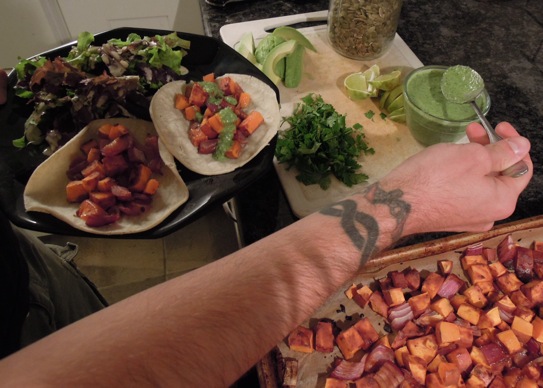
miso-maple sweet potato tacos with coconut-cilantro sauce

This entry is my 200th blog entry! 200! I have come a long way!

The bodega just steps away from our house sells packs of corn tortillas for a ridiculously low price, so whenever I get in the mood for some tex-mex-type food, I stop by and pick some up. The problem is that each pack contains like 6 million tortillas, and there are only so many taco nights I can put up with in the pursuit of using them up. I mean, I've also used them for enchiladas and daiya quesadillas, and even filled them with chocolate chips for dessert once, but you get tired of the same flavors all the time. And still, 50 unused tortillas greet me every time I open my fridge.

So I was psyched when I saw a recipe for Miso-Maple Sweet Potato Tacos with Coconut-Cilantro Sauce on the Kitchn. The combination of flavors is one I would never go for on my own, and it is a refreshing twist on taco night!
The miso-maple glaze is really delicious on the sweet potatoes. I found that it made EXACTLY enough for brushing the sweet potatoes and onions once, and was definitely enough flavor. The roasting took 30 minutes, exactly, which was enough time for me to get everything else ready. The sauce was easy, subtle and delicious. I found myself putting more than I expected on each taco. It has equal parts basil and cilantro; I don't know if I would've known it had cilantro in it at all if I hadn't made it myself. If you don't like cilantro, you can use parsley instead without changing the flavor very much.

We garnished with avocado, pepitas, more cilantro, and lime juice. This recipe is definitely going to make it into the weeknight rotation.

Now that I've found another delicious use for the tortillas, I think I'm ready to graduate up to the large packs of GORDITAS at the bodega. But guys, what can I do with gorditas? I need suggestions!

10.09.2011

Sunday Brunch: Tofu Benedict/Florentine

Did I ever mention that I have a garden? I have a container garden out on our fire escape. I kept meaning to take pictures of it and to write about it this summer, but I guess I just never got around to that. Well, there was a cold snap in Boston earlier this week, and my basil decided it was time to pass on. I've been harvesting as much of my little garden as I can this week, but I managed to snap a quick picture this morning.
It's not as abundant as it was in the summer. The dill went to seed a while back, and the chard is actually replacing the cilantro, which lived its life and died over the course of the summer. Container gardening is actually pretty easy, it turns out, as long as you don't forget to water the plants every other day. That almost killed my garden a couple times this year.

ANYWAY, early on in the summer, when the garden was just starting up, the fiance requested tofu florentine for brunch. Not having spinach (which, I discovered, turns "benedict" into "florentine"--I had no idea), I used some tiny new arugula from our garden just to top the potatoes--microgreens!
You know how food people always say arugula is a "peppery" green? Meaning it has a little kick to it like pepper does? For some reason, I've always tasted that kick as being rather sulfury, and therefore eggy. So for me, arugula is the perfect green to serve with brunches involving tofu eggs. Arugula has a really short growth cycle; it takes less than a month to mature. So I've replanted every three weeks, and we had arugula all season.

I made tofu florentine again this morning, and we had what is probably the last batch of arugula for the season on top.
(Mmmm and the cheesy sauce is still steaming.) Goodbye, little container garden! And thanks for adding so much green to our meals... including our Sunday brunches!

9.14.2011

salted caramel sauce (from design sponge)

As you may know from my links page, I love home design blogs. I usually read them for decorating and DIY ideas for around the house, but often design blogs also delve into food. Apartment Therapy, for example, has the Kitchn section, where I've gotten plenty of recipes. Their vegan ones are often uninspired, but maybe that's only because I already read so many vegan blogs and own so many vegan cookbooks that I feel like I've seen it all. However, since I don't read many non-vegan food blogs, nor do I read many non-vegan cookbooks, I find them useful when it comes to finding new things to veganize.

This Salted Caramel recipe is an example of that. I found it on Design Sponge, a design/DIY/occasional recipe site.
The original recipes calls for lots of butter and cream. I used Earth Balance and some Mimicreme instead. It turned out great!

This caramel is thin at room temperature, but thickens to a sort of paste-y texture once stored in the fridge, so it should really be called Salted Caramel Sauce or Spread. Mine was a bit grainier than the one in the recipe, but that was entirely due to me allowing the sugar to crystalize (oops) while it was cooking, not due to veganizing.

One note about stirring melted sugar: the recipe warns not to overmix, or the sugar could crystalize. I have never had sugar crystalize on me until I read this warning and tried not to "overmix." By not stirring often, I found it crystalized much more than when I do my normal amount of (frequent) stirring. So if you are a beginner, ignore when it says not to overmix.
I served it with fruit slices to my omnivorous book club and they gobbled it up. I also drizzled it over chocolate cupcakes as a glaze, which was a wild success with my omnivorous coworkers--it doesn't taste like a veganized version of caramel--it just tastes like caramel. It would be delicious over ice cream, or spread over some dessert bread, maybe? Ohhhh man like a chocolate bread. I'm making myself hungry just thinking about it.

In other news, I know summer is really over... because my flower CSA share is coming to an end. But I still have some flower pictures to share with you!
The gladioli are always so gorgeous! But really hard to carry home with me on the T; I keep worrying I'll smack someone in the face with a flower.
Sometimes there are too many flowers to keep in one vase, which means I get to scatter them throughout our apartment! I love this delicate-looking (but long-lasting) purple flower. I don't know what kind it is though--anyone know?
I also love THESE expressive flowers! They remind me of brains, so I think of them as "brain flowers," though I'd love to know their real names.

1.13.2011

what to do with 8 cups of pomegranate juice, brought to you by POM Wonderful

By the time I was in the third grade, I had read all of the fiction in my elementary school library. The librarian, eager to support a young nerd's love of reading, recommended me to the nonfiction sections of the library that closest resembled fiction: folklore, history, mythology. Of all the books I read from the school's dusty, not-updated-since-before-I-was-born nonfiction stacks, three have still stuck with me: a biography of Lady Jane Grey, a collection of pre-1900 American ghost stories, and most influential of all, Edith Hamilton's Mythology.

One of my favorite myths in Mythology was that of Persephone. (I assumed it was pronounced "Purse-i-fone," but hey, I was 8.) No matter how many times I read the tale, I still wanted to yell at her when she was about to leave Hades's kingdom: "Persephone, don't eat that pomegranate seed!" Having read the folklore section, I already knoew that you are never supposed to eat food otherwordly entities give you, because then you'll be under their spell. Not to mention the fact that Hades had a whole FEAST in front of her, and when she finally caved and ate something, all she chose was a seed? I found it frustrating. But then, I'd never had a pomegranate. I wouldn't eat my first pomegranate for 12 more years, and when I did, I understood right away why Persephone caved and ate some. They are delicious!

So back in November, when the nice people at POM Wonderful contacted me to ask if I was interested in trying a case of their 100% Pomegranate Juice, of course I said yes. Pomegranate juice gives you all the deliciousness of pomegranates without the work, mess, or chewing. When 8 lovely 8-oz bottles of POM Wonderful's awesome pomegranate juice arrived at my door, I was really excited to try some pomegranate recipes.

But first I had to line them up and photograph them, since I'm weird and obsessive like that.
So, what to do with 8 Bottles of pomegranate juice?

Bottle 1: I just drank it. I always water down juice (I don't really like sweet drinks), so I ended up mixing the pomegranate juice with seltzer to make a spritzer. It's good stright, though, if you're into juice. If you've never had pomegranate juice or pomegranates, for that matter, imagine a darker, richer-tasting, slightly sweeter version of cranberry juice. Also, if you haven't tried pomegranates or pomegranate juice, seriously, try some.

Bottle 2: Pomegranate Tofu with Walnuts.
I was inspired by this chicken recipe.

First, I dredged chunks of tofu in cornstarch, flour, salt and pepper, then sauteed it in a tiny but of oil until browned.
The goal was to give the tofu a crispy layer that would soften and resemble a skin as it cooked. For the record, It worked, but to be honest, next time I'd do without the coating and just brown the tofu. It's easier, and no one really needs their tofu to have a skin. So the instructions below are for skinless tofu.

1 16-oz block tofu
2 Tbsp olive oil, divided
1 large onion, finely chopped
1.5 Cups walnuts, roughly chopped
1 cup fresh pomegranate juice
2 Cups water
2 tsps lemon juice
1 tsp sugar
1 tsp salt
1/2 tsp cinnamon
1/2 tsp pepper
optional: 1 tsp cornstarch, stirred into 1-2 Tbsp water

First, press the tofu if you have time, to get out excess moisture. Cut tofu into bite-sized (or larger) chunks. Heat 1 Tbsp of the oil in a large skillet over medium heat and saute the tofu, allowing to brown lightly on each side. Meanwhile, chop the onion and the walnuts. Remove the tofu from the pan; add the remaining 1 Tbsp of oil to the pan, then add the onions and walnuts. Cook until the onions are wilting and starting to brown, stirring as often as you need to not to let the walnuts burn (but they should brown, too).

Add the remaining ingredients, and cook until the mixture boils. It will not look very pretty, but that's okay--it is delicious.
After the mixture comes to a boil, add the tofu. Now your goal is to cook it until the sauce reduces enough to glaze the tofu and thicken a bit; 10-20 minutes, depending on how high your definition of "medium heat" is. You do want some liquid at the bottom of the pan throughout cooking so nothing burns or browns. If you have a lot of walnut meal, it may thicken as it cooks, so you may need to add more water (up to a cup)--and if you want it to thicken more than it's doing, you can add the optional cornstarch mixture, then stir another 3 minutes. This serves 3-4.

If you read my edible gift post, you already know what I did with Bottles 3-6: Homemade Grenadine.
Grenadine is a great mixer for alcoholic and non-alcoholic drinks, as well as a useful, beautifully colored addition to baked goods. Most grenadine you find in stores is far removed from its pomegranate roots, containing little more than high fructose corn syrup and food coloring. As I said, I got the original recipe from The Cupcake Project, but I deviated a little, so I'll give you my version here.

3 Cups pomegranate juice
1 1/2 Cup sugar
1 more Cup pomegranate juice

Put the first 3 Cups of pomegranate juice in a saucepan over high heat. Bring it to a hearty boil.
Reduce the heat to medium, and let simmer until reduced by half. Remove from heat, stir in the sugar until dissolved.
Here's where I differ from The Cupcake Project: once all the sugar has dissolved, whisk in the remaining 1 Cup Pomegranate juice. Why, you ask? Well, boiling and reducing pomegranate juice takes away much of its characteristic tartness, and gives it a mellow, thicker, cooked taste. Adding the extra cup of fresh juice gives it back the kick it lost while making it taste a little lighter, all without detracting from the new grenadiney taste.

Store in a tightly-sealed container in the refrigerator. It will keep for a long time; at least 4-6 weeks.
I like to mix grenadine with seltzer for an Italian soda, but it is most commonly used in cocktails (including non-alcoholic Shirly Temples).

Bottle 7: Pomegranate Granita
Granita is basically Italian ice. It's a chunkier, icier sorbet, and it goes GREAT as a light dessert or as a complement to cookies. It is very easy to make granita, but it's one of those things people assume you spent a lot of time on. I like pomegranate's tartness, so I didn't sweeten it very much, but if you don't want it very tart, increase the sugar to 1 Cup. If you want it tarter and with more intense flavor, add another cup of pomegranate juice.

1 Cup pomegranate juice
1 Cup water
1/2 Cup sugar

Pour the pomegranate juice into a glass baking dish. Set aside.

Combine the water and sugar in a small saucepan and stir them over high heat until the sugar is completely dissolved. Remove from heat, pour into the glass dish. Put the glass dish in the freezer. Every 20-30 minutes, remove from the freezer, use a fork to break up all the ice that forms on the top, sides, and bottom of the dish, stir, return to the freezer. In 2-3 hours, you will have an Italian-ice-like dessert!

This serves 2-3 if you give each person a bowl of it; 4-6 if you have dainty little cups of it to accompany a richer dessert.

Bottle 8: Maple-Pomegranate Sauce.
The boyfriend made this, because he is a champion. He combined equal parts pomegranate juice and maple syrup, the seeds of one pomegranate, and 1-2 Tbsp cornstarch (I wasn't paying attention) to make the most delicious pancake topping I've had in quite a while.
And that brings us to the end of the case of pomegranate juice.
So empty, so sad.

I am a big fan of pomegranates, so I already liked POM Wonderful before they sent me anything, but I am an even bigger fan now that they gave me the opportunity to spread my love of pomegranate to you readers. I've noticed that POM now sells containers of pomegranate arils (the seeds), which saves you the work and mess of having to dig them out of the fruit yourself. So you can feel like Persephone by daintily sampling one seed any time you want!*

*-And then, if you're like me, you can feel like a nerd for remembering and being excited about emulating a Greek myth.

10.12.2010

beurre blanc, vegan mofo, and site revamping

Before I went vegan, I hadn't tried a lot of foods. I grew up in a small town in Upstate New York, where availability of fancy and/or ethnically diverse foods was limited to the "ethnic" section of the grocery store--which had taco shells, a few kinds of hot sauce, and couscous. Oh, and maybe some artisan olive oil. Going vegan made me think about food, and definitely made me cook more (my mother was, at first, at a loss as to what to make for me to eat). The more confident a cook I become, the more challenges I end up wanting to take. "What other cool techniques can I try?" I ask myself. "What other non-vegan things can I veganize?"

The more experimental I get in cooking, the more recipes I look at that I wouldn't've considered before. Last spring I read countless brisket recipes to develop my own seitan brisket (more on that in another entry); I poured over recipes for chicken cordon bleu to get my vegan cordon bleu up to par. SO when Francis Lam published a recipe for beurre blanc on salon.com, I ate up that recipe with gusto.

For those of you who, like me (well, before I read that recipe, and then read Julia Child's anecdote about learning to make it), don't know what beurre blanc is, it is a butter sauce. "Beurre Blanc" means "white butter." If that sounds overly simple, that's because it is. It's butter, white wine or vinegar, vinegar, shallots, and maybe some lemon juice and pepper and salt if you feel like it. It's very simple in ingredients, but complicated in taste. And not just in taste--if you read Lam's article, you'd be under the impression that it's really hard to make. While the article does say how delicious it is, it makes it sound almost too intimidating.

I am here to tell you that if you are vegan, you can disregard the "intimidation" and "difficult" aspects. Earth Balance margarine is apparently a lot more forgiving than butter. Also, while I don't really have that much of a problem eating fatty foods, I do have a bit of a problem using so much margarine for one recipe (it's pricy!). So I have tried Lam's recipe twice with half the recommended amount of butter, and it was great. Never having had a non-vegan beurre blanc sauce, I imagine it's supposed to be thicker, but for a beurre blanc with half the fat, a thinner sauce is totally worth it.

Beurre blanc is great poured over greens, baked tofu, vegan cordon bleu, or just over bread. It's a chunky (well, you can strain it, but I don't) beigeish sauce, so it's not very photogenic, but trust me, this is AWESOME. Much more than the sum of its parts.
This recipe will easily serve 8, more if you're not so generous with your servings as I am.

Vegan Beurre Blanc

1 medium shallot (or 1/4 C of an onion), diced small
1 C dry white wine*
3 Tbsp vinegar (I used apple cider vinegar, but white wine vinegar would be good, too)
2 sticks Earth Balance of other vegan "butter" (if you use the tubs instead of the sticks, that's 16 Tbsp or 1 C, but save yourself some work and get the sticks for this!)
Lemon juice
Salt and/or pepper if you want

In a medium-to-small saucepan, combine the wine, vinegar, and shallots, and bring to a boil. Boil this down until almost all the liquid is gone; you want to cook it down until there are 2 tablespoons of liquid left. Stir occasionally to make sure the sides aren't burny.

In the meantime, take the earth balance out of the fridge and divide it into chunks that are approximately tablespoon size. (They can be a little bigger if you want to sace yourself on time.)

When the liquid on the stove has cooked down to just 2 Tbsps' worth, turn the heat down to low whisk in 2-3 Tbsp of the butter. Whisk well, until the sauce is a consistent texture. Once the butter is incorporated, keep adding 2-3 Tbsps of the butter at a time and whisking till emulsified. Once all the butter is worked in, you're done! Taste-test: it will be delicious, but if it feels a little greasy, add a tsp of lemon juice at a time until the flavors are balanced. If it seems to acidic (it probably won't), you can whisk in a little more butter.

It is ready to serve! Enjoy! It is especially good on beets, tofu, and bread...
The Beurre Blanc won't really keepy as a sauce; once it cools to room temperature, it separates a bit and and thickens. Store leftovers in a small container and use as a flavored butter (stir with a fork or knife before spreading), or as the base to sauteed pastas or veggies later.

*-Note: We never have white wine lying around, so as a general rule to replace 1 C white wine in cooking, I use 3/4 C water, 2 Tbsp apple cider vinegar, 1 Tbsp agave or other sweetener, and 1 Tbsp vodka or clear rum (optional; it cooks out but still lends a bit of an "alcohol was here" taste to a dish).

Now that the recipe's out of of the way, I have two more things:

First, the Vegan Month of Food is coming up in November. If you are unfamiliar with it, VeganMoFo is a month where vegan bloggers try to post every day. I've never participated in it before because of my inability to post even once a week with regularity, but this November, I'm up to the challenge! Check out more info on VeganMoFo (and sign up to participate) at the VeganMoFo headquarters.

Second, hopefully before November, I'm planning to revamp this blog. I think one of the reasons I don't post here as much is that I don't always enjoy writing about food (gasp!)... but I do really enjoy writing. So definitely for VeganMoFo but probably beyond, I'm looking to expand my content a little to around-the-house and around-Boston topics. And I'd like to include a little more about me--I realized recently that, beyond what I eat/don't eat, I don't really write much about who I am in this blog. And this layout could use a bit of a makeover.

Writing that made me curious: Bloggers, do you ever get tired of your content? What do you do to refresh or revamp your writing style or presentation? How do you strike the balance the personal and the impersonal? Readers without blogs, do you like learning more about the people behind the blogs you read? What do you think is a good balance of "about the author" and actual content in entries? What's the difference?

10.07.2010

Rebecca: Vegan Cordon Bleu

I love food and I love to read. As a result, the first week of each month, I'll combine these two interests in a post about food from literature. I'll mostly be sticking with books from classic literature, so you're likely to know the storylines anyway, but just in case you don't: warning: there may be spoilers ahead.

---------------------------------------------------------------------------------


It took me a long time to read this book. Not actually to get through it; it is a riveting book that you won't want to put down once you pick it up. But picking it up was the hard part for me. The cover didn't help. As you can see, the cover of my copy looked like a romance novel. Other editions' covers are boring: plain text, plain colors; they make it look like an "important" (but not particularly interesting) book.

Plus, the first chapter is rough! The famous opening line "Last night I dreamt I went to Manderley again" leads into an evasive, depressing, and somewhat confusing first chapter set well after the rest of the events in the book. This put me off at first. BUT when I actually finished the book, I quickly flipped back to the beginning to look through this chapter.

Even though I have a little disclaimer at the top saying there might be spoilers, and the academic in me laughs in the face of spoilers, I hesitate to ruin anything about this book for you. The joy, the craft, the genius of this novel is in Du Maurier's ability to build suspense throughout hundreds of pages. You can guess what's happening, you can think you know what's happening, and by a certain point you may be sure you know what's happening--but you're still waiting with baited breath for the big reveal at the end.

Okay, so that settles it: no spoilers. A safe plot summary: Our nameless narrator is a painfully shy young woman from a poor background who meets a dashing older widower, Maxim de Winter. Maxim marries her and takes her to his huge, lavish estate: Manderley. The young Mrs. de Winter, already feeling unworthy and out of place in her new surroundings, struggles with the duties of managing a household, one that teems with servants and rooms that still seem loyal to their dead mistress. No one wants to talk about Rebecca, the last Mrs. de Winter, except the creepy servant Mrs. Danvers, who brings up Rebecca mostly to make the narrator feel more unworthy and uncomfortable.


Mrs. Danvers being creepy in Hitchcock's film adaptation.


Over the course of the novel, the insecure little narrator begins to unravel some things that don't make sense about Rebecca's life and death, and Rebecca, though dead, becomes the most important, compelling figure in the text.

Other than the gothic tone and the compelling tension throughout Rebecca, my favorite thing was the main character, the new Mrs. de Winter. The narration is from her point of view, and we spend a lot of time in her head, going through her thought processes with her. I'm not a shy person, so our narratrice's (that's a word, right? I know I've used it before, so we'll pretend it is) inability to speak or step up at key moments frustrates me--but thanks to du Maurier's narrative, I at least understand why the narratrice acts the way she does, even if I wouldn't be that way myself.

The plot really centers around the fact that no one will be direct with anyone else. The narratrice doesn't understand the strange situation at Manderley, but is too shy and insecure to ask anyone directly. Maxim, her husband, is trying to protect her and, to an extent, himself, so he won't give her direct answers. Maxim's lawyer, his sister, and his brother in law all try to tip-toe around Maxim for fear they'll upset him by bringing up the past, and Mrs. Danvers hates everyone now that Rebecca's dead, so she won't say anything that isn't creepy and mean. If, in the first few chapters, our narratrice said "Look, Maxim, what is the story with your dead wife?" or "Mrs. Danvers, you are creepy and crazy and this is my house now, too," or "Frank/Beatrice/Giles [anyone, actually], just tell me what's going on with my husband and household," there wouldn't be any tension. But again, the best part of this book is that tension. We understand the mindset of the narratice so well that we see why she doesn't say things like that, even if she really wants to; even if we really want her to.
Despite all the actual action that takes place, for me, the turning point of the novel is a conversation between Maxim and his wife. This is the genius of Rebecca: the book builds up lack of communication so well throughout that a conversation between a husband and wife is the exciting climax. And it is exciting. Again, trying not to risk spoiling anything, after this moment, the main character begins to have more confidence and more volition. Since we, as readers, spend the entire text in her head, watching this turn is incredibly satisfying.

And here is where the food comes in. The food that the kitchen prepares for the de Winters and their guests is a point of power for creepy Mrs. Danvers. She almost bullies the shy narratrice into what they will serve for guests. After the climactic discussion, when our narratrice begins to act with a will of her own, she directs the kitchen and Mrs. Danvers what to make and how to serve it. It's a minor point in the book, but a big deal for the main character--and, because we've been sharing in her thoughts and anxieties, a big deal for us.

When I first finished Rebecca, I thought, well boo, I can't write about this for my blog, because all the food in this is not vegan, and wouldn't be fun to veganize. The characters eat baked chicken, souffle, salmon and lobster mayonnaise (what the heck is that, anyway?). Ritzy stuff consisting of several animals. Not themes I wanted to incorporate into my blog, anyway.

Until the boyfriend's birthday. He requested, for dinner, a vegan version of Chicken Cordon Bleu. I was hesitant to comply, as I'd never had a non-vegan version, but then, I don't think he had, either, so I gave it a shot. And, while making it, I realized: Chicken Cordon Bleu is exactly the decadent, fattening, multi-animal kind of dish Mrs. Danvers (the creep!) would have served.

Finding a good substitute for the chicken was tricky. I thought about seitan, but wasn't sure how to flavor it; I wanted a light flavor, and most seitan recipes are rather heavy. The texture, too, needed to be bake-able, not to dry out. I ended up going with Veganomicon's Chickpea Cutlets. With their lemon zest and added beans, the cutlets tasted bright and didn't dry out in baking. A great choice. Also, for the filling: I dislike buying most vegan cheeses and fake meats, mostly because they're expensive and not usually very tasty, but I only had a couple hours to put together this dinner, and I didn't want to mess anything up by making a too-thin or too-thick cheese sauce of my own... and it was really hot, so I didn't feel like using the oven to make homemade tofu bacon. I bought and used Yves Canadian bacon and Follow Your Heart cheese, but feel free to use/make your own favorite kinds of vegan bacon/cheese.

Finally, I read through dozens of recipes for Chicken Cordon Bleu, and there didn't seem to be a consensus as to whether you bake the chicken or saute it in butter. I went for baking, but I suspect that with gentle treatment, sauteing would work. I include sauteing ideas in my instructions below.
Vegan Cordon Bleu

1 recipe Chickpea Cutlets (from the Veganomicon) (Because I'm allergic to nightshades, I always leave out the paprika and just put in 1/4 tsp or more of black pepper. It still tastes awesome.)
4 thick slices of vegan cheese (or 1 cup shredded cheese or thick cheese sauce)
4 slices vegan Canadian bacon (or normal-sized veggie bacon)
Bread Crumbs--about 1 cup should do, on a plate or in a shallow bowl.

If you want to bake these, preheat the oven to 375, and generously grease an 8x8 baking dish. I strongly recommend greasing the dish by melting 2 T margarine in it by putting it in the oven as it preheats. The buttery taste is all the more decadent. If you want to fry/saute them, see below.

Make chickpea cutlet dough according to the recipe. Divide into four equal parts. Take one of the fourths, and knead and stretch it into a strip at least 4 inches long and 2-3 inches wide. If you can get it wider, all the better, but you don't want any holes in it. Because gluten is so elastic, it'll shrink if you don't keep tugging it back as you work. Once you've got it to a good size, put the Canadian bacon down along one end, put the cheese on the middle of that (one slice, or about 1/4 a cup if you're using shredded), then roll it up, starting at the bacon/cheese end. The gluten will stick to itself pretty well. Close the ends upon themselves (if you can't do so without tearing the dough, don't bother). Roll the completed rolls in the breadcrumbs, making sure to get all sides. Repeat with the other three segments of dough.

If you are baking them, put the four rolls, seam-side (where you sealed the roll) down, in the baking dish. Brush a little oil/melted butter over the top of each one. Bake for about 30minutes, until the breadcrumbs start to turn golden-brown.

If you want to fry/saute them, heat your oil/margarine in a cast iron pan over medium heat. If your rolls are holding together well and you can be very gentle in flipping them, then put them in the pan as is. If they look like they might come apart, stick a toothpick through each one, and trim the ends of the toothpick that stick out, so it'll saute on those sides. (Just remember to remove the toothpicks before you eat!) Rotate the rolls as they cook, making sure each side gets to a nice toasty golden color. This might take a while (up to 20 mins with all the rotating), and you may need to add more butter/oil if the breadcrumbs soak it all up, but it'll be very decadent and delicious.

These don't need a sauce, but if you want to, serve with a salad that has a ranch-type (that is, creamy) dressing, or pour beurre blanc over the vegan cordon bleu, which I'll feature in an entry next week!

[EDIT: GUYS, I just remembered: "Narratrice" is French. While I like English's abundance of gender-neutral words, sometimes when you're talking about a female narrator, you just want to be able to use a word that means "female narrator." Thanks, French.]

7.26.2010

fresh summer rolls and my new obsession with jellyfish

The boyfriend and I live on the third story of a three-story building. In the winter, our location allows us to save money on heat bills: heat rises from the units below, and comes down through the not-very-well-insulated roof. However, in the summer, our place is consistently 5 degrees hotter inside than out--and with temperatures consistently above 90 degrees in Boston this month, we have been sweltering. I still cook most nights, but sometimes we just have to escape to restaurants for warm food, or eat meals that involve little or no cooking.

The boyfriend is fine with salad every night, but not me! So last week I made fresh summer rolls, a quick dish that, depending on your ingredients, can be a simple side or appetizer or a filling entree. Note that summer rolls are the uncooked cousin of spring rolls, wrapped with rice paper instead of wheat-based wrappers. If you can't find rice paper your grocery store (though if your store has an "Asian" section, it should be there), they are always available at Asian markets. Like tortillas, they come in varying sizes; if you can only find the 12-inch ones, just use a lot more filling per wrapper. Unused wrappers should be stored in a resealable plastic bag so no moisture gets in.
Before you begin with the rice paper, gather and chop all of your fillings. The ingredients you use to fill summer rolls are flexible, but they should all be cool at the time of rolling. Good ingredients include (but are not limited to): lettuce, vermicelli noodles, cilantro, mint, bean sprouts, strips of marinated tofu (or other protein, cooled if cooked), chopped mushrooms (cooled if cooked), grated or julienned carrots, shredded cabbage, julienned cucumber.My ingredients were (clockwise from the top left): chopped mint, pea shoots, carrots, finely chopped mushrooms I'd sauteed with garlic and soy sauce earlier in the day, and spinach.
Fill a pie plate or baking dish with about an inch of lukewarm water. Slide in one sheet of rice paper, and allow it to soak until softened, about 30 seconds.
Remove from the water, hold it above the dish for a second to let the excess water drip off. It'll be really floppy and will stick to itself almost as easily as saran wrap. Lay on a flat surface. [Right now, as a sort of assembly line process, you can put another wrapper into the water while you fill and roll this one] Place 2-3 Tbsp worth of filling (or just small handfuls/spoonfuls of each ingredients) near the bottom of the sheet. Fold in the sides and roll it up from the filled bottom, just like you'd do with a burrito. The roll will stick to itself at the ends, so it won't come apart.
Ta dah! Now, for sauces. I like to have a variety of choices. Any bottled Asian sauces will do, but to make your own, I recommend a sweet-and-sour sauce that is almost equal parts vinegar and sugar or mirin. (For a thicker texture and less sweetness, do what I do and do equal parts apple sauce and vinegar, pictured below.) There are good recipes for this available all over the internet (for the first link there, scroll down to the bottom for a few different sauces, substitute soy sauce for fish sauce). Hoisin sauce is a HUGE favorite of mine; this recipe is really simple. (I omitted the hot sauce and added extra pepper.)Also, for something a little heavier and with more protein, a good peanut sauce is always nice. I made this this one but didn't heat it, just stirred it a lot... and added some extra water, and baked it with tempeh to really round out the meal:
Yum!

While I was making these summer rolls, I couldn't help but think of jellyfish. Of course, everything makes me think of jellyfish lately; I'm obsessed. Before this past month, I had only ever seen jellyfish in aquariums, so I assumed they were tropical creatures, like sea horses. However, I work by the Boston Harbor, and sometimes I take breaks to walk by the water. AND GUESS WHAT I HAVE SEEN IN THE WATER:
JELLYFISH. IN NEW ENGLAND. I've since told everyone I know about this, and almost no one else is surprised. I guess everyone but me knows that wherever there is salt water, there are usually jellyfish. Seeing these little guys by my office inspired me to do some research. Jellyfish especially thrive in areas that are overfished and/or get runoff and other pollutants in the water. While most jellyfish sting, these little guys, the one most common in New England, are Moon Jellies (Aurelia aurita), which do not sting.
Earlier this month, some friends and I went out to one of the Boston Harbor Islands, which have ample areas for hiking, swimming, and soaking in gorgeous views of Boston:When we first went on the beach of the island, the tide was out, and I discovered that jellyfish frequently wash up on shores during low tide. Though they are dead, they are still soft to the touch. My friends and I were at first too timid to touch them, since, after all, jellyfish who do sting can hurt you even when they're dead, as people on New Hampshire beaches learned last week, but two 5-year-old girls came running down the beach and were literally juggling the dead little jellies, so I guess there really is no need to fear moon jellyfish.
Seeing the jellies on the beach really allowed me a chance to see their anatomy; it's hard to see it when they're alive in the water because they move all the time. But one thing I noticed about their anatomy:
THEY TOTALLY RESEMBLE RICE PAPER.